
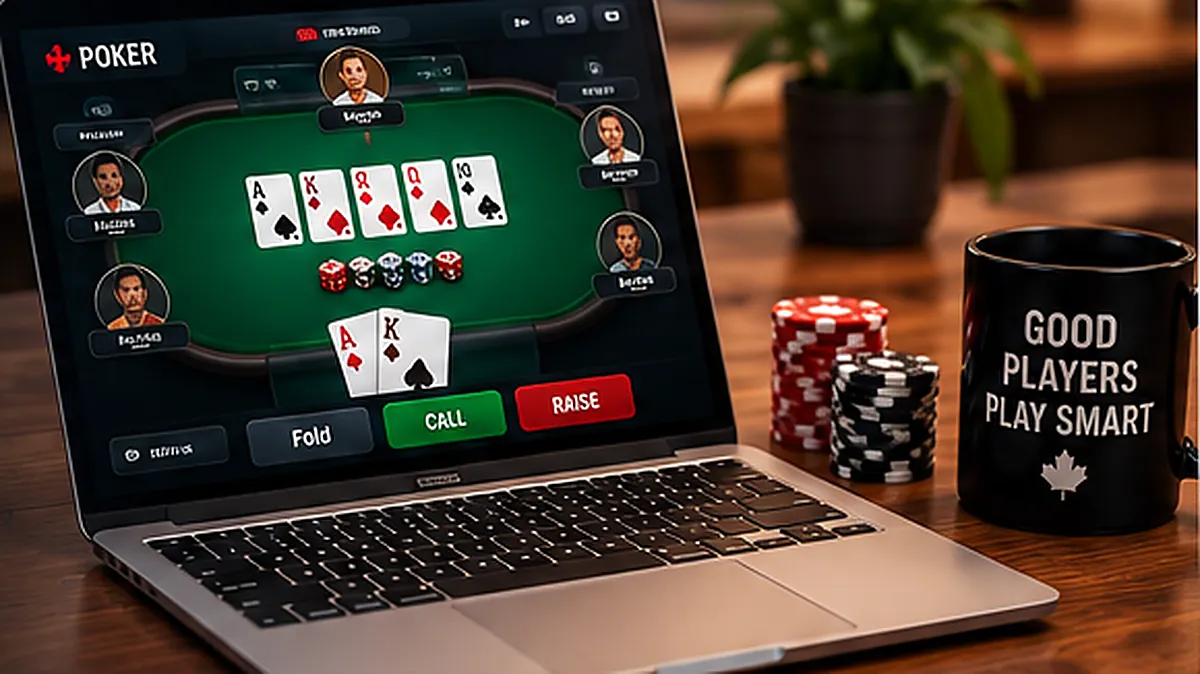
Standard poker hand ranking
| Rank | Hand |
|---|---|
| 1 | Royal Flush |
| 2 | Straight Flush |
| 3 | Four of a Kind |
| 4 | Full House |
| 5 | Flush |
| 6 | Straight |
| 7 | Three of a Kind |
| 8 | Two Pair |
| 9 | One Pair |
| 10 | High Card |
How Online Poker Works
At its core, poker is a game of incomplete information, where players use a combination of their own cards, community cards (in most popular formats), and betting behaviour to make decisions with only partial knowledge of what opponents are holding. Unlike blackjack or roulette, poker isn't played against a fixed house edge - instead, the platform earns revenue through a "rake," a small percentage taken from each pot (in cash games) or an entry fee (in tournaments), meaning your actual opponents are the other players at the table, not the operator itself.
This structural difference is why poker skill matters so much more than in other casino games. A player who consistently makes better decisions than their opponents - reading betting patterns, calculating odds accurately, and managing their bankroll wisely - can be a long-term winning player, something that's mathematically impossible in a pure house-edge game like roulette or slots.

Popular Online Poker Formats
Texas Hold'em is by far the most popular poker variant worldwide and the format most Canadian online poker rooms are built around. Each player receives two private "hole cards," with five community cards dealt face-up in stages (the flop, turn, and river) that all players share to build their best possible five-card hand.
Omaha shares Hold'em's community card structure but deals four hole cards instead of two, with the added rule that players must use exactly two of their hole cards combined with exactly three community cards. This structural difference produces stronger average hands and generally more action-heavy play than Hold'em.
Seven-Card Stud predates the community-card formats and deals each player seven cards total (a mix of face-up and face-down) over several betting rounds, with no shared community cards at all. It's less common at modern online rooms but retains a dedicated following.
Tournaments vs. Cash Games represent the two fundamental ways to play any of the formats above. Cash games use real-money chips that directly correspond to their table value, and players can join or leave at any time. Tournaments require a fixed buy-in, award chips with no direct cash value until the tournament concludes, and typically pay out to a percentage of finishers based on where they place - with blinds increasing over time to push the game toward a natural conclusion.
Sit-and-Go tournaments are a smaller-scale, faster alternative to full multi-table tournaments, starting as soon as a table fills (often 6 or 9 players) rather than at a scheduled time, and typically concluding in well under an hour.
Basic Hand Rankings
Understanding hand rankings is foundational to every poker format. From strongest to weakest, the standard ranking order is: Royal Flush, Straight Flush, Four of a Kind, Full House, Flush, Straight, Three of a Kind, Two Pair, One Pair, and High Card. Knowing these rankings cold - without needing to pause and calculate mid-hand - is a prerequisite for making sound decisions at the speed real games require, particularly online where decision timers add real time pressure.
Beginner Strategy Fundamentals
Play fewer starting hands, but play them more aggressively. One of the most common beginner mistakes is playing too many weak starting hands out of a desire to "see more flops." Tightening your starting hand range - particularly from early table position - and betting or raising confidently with the hands you do play is a foundational shift that improves most new players' results significantly.
Position matters more than most beginners realize. Acting later in a betting round gives you more information about your opponents' likely holdings based on their actions before yours. Hands that are marginal from early position can become clearly profitable from a late position, where you've already seen how several opponents have acted.
Pay attention to bet sizing, not just actions. A small bet and a large bet can represent very different hand strength ranges depending on the player and the situation - learning to read sizing patterns, not just whether someone bets, checks, or raises, is a meaningfully more advanced skill worth developing over time.
Understand pot odds at a basic level. Comparing the size of a bet you're facing to the size of the pot helps determine whether calling is mathematically justified based on your hand's likely chances of improving or winning. This doesn't require complex math at the beginner level - even a rough sense of "is this call cheap relative to the pot, or expensive" meaningfully improves decision quality.
Don't let emotions drive your decisions. "Tilt" - playing worse due to frustration after a bad beat or a losing stretch - is one of the most common ways otherwise skilled players lose money. Recognizing when you're tilting and stepping away from the table is a genuinely valuable skill, not a sign of weakness.

Online Poker vs. Live Poker: Key Differences
Pace of play. Online poker moves considerably faster than live poker - more hands per hour, shorter decision timers, and often the ability to play multiple tables simultaneously ("multi-tabling"), which changes both the strategic and the bankroll-management calculus compared to a single live table.
Reduced physical tells. Without being able to see opponents in person, online poker strategy leans more heavily on betting patterns, timing tells (how quickly or slowly someone acts), and historical tendencies rather than physical cues like body language.
Access to tracking tools. Some online poker platforms allow or restrict the use of tracking software that logs opponents' historical tendencies - rules vary significantly by platform and jurisdiction, so it's worth checking a specific room's policy before assuming any tool is permitted.
Lower stakes accessibility. Online rooms typically offer a much wider range of stakes than most live venues, including "micro stakes" tables that make it possible to play and genuinely learn the game for very small amounts of real money.
Canadian Online Poker Liquidity
Poker is unique among casino games in that its quality depends heavily on the number of active players at a given stake level and format - a phenomenon known as liquidity. A poker room with a thin player pool at your preferred stakes can mean longer waits for a table to fill, less game variety, and weaker overall game quality compared to a room with deep, active traffic.
This is a genuinely relevant consideration in Canada's current regulatory landscape. Ontario's competitive market has been open since 2022 and has built meaningful poker liquidity over that time, while Alberta's newly launched market (July 2026) is still establishing its own player base - a concern regulators and operators have both acknowledged given Alberta's smaller population relative to Ontario. A pending Supreme Court of Canada case could determine whether Ontario and Alberta players can be connected with players in the United States for liquidity purposes, a decision that could meaningfully affect poker specifically given how directly liquidity impacts game quality. Checking your province's iGaming regulation guide is a good way to understand what's currently available where you live.
Choosing a Poker Room in Canada
Licensing and player fund security. Confirm any poker room is properly licensed for your province, and look for information on how player funds are segregated from operational funds - a genuinely important protection in the event an operator faces financial difficulty.
Game selection and stakes range. Look for a room that spreads your preferred format (Hold'em, Omaha, or others) across a range of stakes that match your bankroll, from micro stakes for beginners to higher stakes for experienced players.
Rake structure. Rake - the percentage taken from cash game pots or tournament buy-ins - varies between rooms and directly affects your long-term profitability as a player. Lower rake, all else equal, is better for players, particularly at lower stakes where rake represents a proportionally larger cost.
Software quality and stability. A room with frequent disconnections, slow interfaces, or confusing table navigation can genuinely cost you money through missed decisions or forced folds during technical issues.
Promotions and rakeback. Many rooms offer rakeback (a partial refund of rake paid) or loyalty programs that reward volume play - genuinely valuable for regular players, though usually less relevant for occasional or beginner players.
Bankroll Management for Poker
Poker's variance can be significant even for genuinely skilled players - a strong long-term winning player can still experience extended losing stretches purely due to short-term luck. Proper bankroll management is how skilled players survive those stretches without going broke.
A commonly cited guideline is maintaining a bankroll of at least 20-30 buy-ins for the stakes you're playing in cash games, or a similarly conservative multiple of your typical tournament buy-in for tournament play. Moving up in stakes before your bankroll genuinely supports it is one of the most common ways even skilled players end up broke - the swings at higher stakes are proportionally larger, and a bankroll sized for lower stakes often can't absorb them.
Our Responsible Gambling page covers deposit limits and other tools that apply to poker just as much as any other casino game, even though poker's skill element means your results are more within your control than in purely chance-based games.
Common Beginner Mistakes
Playing too many hands. Loose, wide starting hand ranges are one of the clearest markers of an inexperienced player and one of the easiest leaks to fix.
Calling too often instead of raising or folding. Passive play tends to be less profitable than a more balanced mix of aggression and disciplined folding - calling stations are generally easier for skilled opponents to play against profitably.
Ignoring position. Playing the same hand the same way regardless of table position throws away one of poker's most fundamental strategic advantages.
Moving up in stakes too quickly. Chasing bigger potential wins before your bankroll and skill level genuinely support higher stakes is one of the most common ways new players go broke.
Playing while tilted. Continuing to play after an emotionally frustrating hand or session, rather than taking a break, consistently leads to worse decision-making.
A Brief History of Poker
Poker's exact origins are debated among historians, with roots often traced to a mix of European card games like the French "Poque" and the German "Pochen," which arrived in North America through French settlers in New Orleans in the early 1800s. The game evolved considerably over the following century, with Texas Hold'em specifically emerging in Texas in the early 1900s before spreading nationally and eventually internationally through the mid-to-late 20th century, aided significantly by the rise of organized tournament poker and, later, televised events that introduced the game to a much broader audience.
Online poker's arrival in the late 1990s and early 2000s represented one of the most significant shifts in the game's modern history, dramatically expanding access beyond dedicated poker rooms and casinos and giving rise to an entirely new generation of players who learned and developed their skills primarily through online play rather than live games. Canada's regulatory landscape for online poker has continued evolving since then, most recently with Ontario's 2022 market opening and Alberta's 2026 launch both bringing licensed poker rooms into a formally regulated framework.
Online Poker Etiquette
Online poker carries its own set of informal conventions worth knowing, even without the physical presence of a live table. Taking excessive time on straightforward decisions, sometimes called "tanking," is generally frowned upon in casual play and can trigger of a hand timer running out and an automatic fold at some platforms. Using chat functionality to discuss a hand still in progress, or to criticize another player's decisions ("chat-bragging" or "coaching" mid-hand), is broadly considered poor etiquette across most poker communities, online or live. Multi-tabling (playing several tables simultaneously) is widely accepted and common at most stakes, though it's worth being honest with yourself about whether managing multiple tables is actually improving your decision quality or simply diluting your attention across too many hands at once.
Poker Glossary
a player's private cards, not shared with other players.
cards dealt face-up and shared by all players, used in formats like Hold'em and Omaha.
forced bets posted by one or two players before cards are dealt, used to ensure action in every hand.
the ratio of the current bet size to the total pot, used to evaluate whether a call is mathematically justified.
a player's seating order relative to the dealer button, with later position offering an informational advantage since more players have already acted.
a state of emotionally-driven, suboptimal decision-making, often triggered by a bad beat or a losing stretch.
the percentage or fee taken by the platform from cash game pots or tournament buy-ins, representing the operator's revenue source.
betting the entirety of your remaining chip stack on a single hand.
the amount of money required to enter a cash game or tournament.
losing a hand despite having been a statistical favourite to win at an earlier point in the hand.
Online Poker Tools and Fair Play
Licensed online poker rooms in Canada operate under regulatory requirements around game integrity, including certified random number generation for card shuffling and dealing. Some platforms permit basic heads-up display (HUD) tracking tools that show historical statistics on opponents you've played before, while others restrict or ban such tools entirely - policies vary significantly by platform, and using a tool prohibited by a specific room's terms of service can result in account penalties regardless of whether the tool itself is legal to use in a general sense. Always check a specific poker room's tool policy directly rather than assuming a tool permitted at one platform is permitted everywhere.
Reading Opponents Through Bet Sizing and Timing
Since online poker strips away physical tells, developing an eye for betting patterns becomes a core skill worth deliberately practicing. A player who consistently bets small with strong hands and large with weak ones (or vice versa) is exhibiting a detectable pattern over enough hands, even without any visual cues. Timing tells - how quickly or slowly a player acts - can also carry information, though they're less reliable than bet-sizing patterns and can be intentionally manipulated by more experienced players aware that timing is being observed. Building genuine skill at reading these patterns takes volume and deliberate attention over many hands; it's not something that develops from a handful of sessions, and new players shouldn't expect to read opponents reliably right away.
Building a Study Routine
Players who improve fastest at poker tend to treat it as a skill worth deliberately studying rather than something absorbed purely through playing volume alone. Reviewing your own hand histories after a session, particularly ones where a decision felt uncertain in the moment, is one of the most effective ways to identify recurring leaks in your own play. Discussing hands with more experienced players, working through basic starting-hand charts for your preferred format, and gradually introducing concepts like pot odds and expected value calculations as your comfort with the fundamentals grows are all part of a sound long-term study approach - far more effective than simply playing more hands without any deliberate reflection on decision quality.
Frequently Asked Questions
It depends on your province. Ontario and Alberta both license private operators offering online poker; most other provinces rely on government-run platforms with more limited poker offerings. Check your province's regulation guide for specifics.
Skilled players can be long-term winners, since poker is played against other players rather than a fixed house edge - but it requires genuine skill development, disciplined bankroll management, and realistic expectations about variance.
Poker has no inherent house edge on individual hands - the rake is the platform's revenue source, and your results depend on your skill relative to your opponents, unlike blackjack, slots, or roulette where the house edge is fixed regardless of skill.
Micro-stakes tables at most Canadian-facing rooms allow play for very small amounts, making it possible to learn the game and build experience without significant financial risk.
Rakeback is a partial refund of the rake a player has paid, typically offered as a loyalty incentive by poker rooms to reward volume play - genuinely valuable for frequent players, less relevant for occasional ones.
Ready to Play?
Poker rewards patience, discipline, and a genuine willingness to keep learning more than any other casino game - there's no fixed house edge standing between you and long-term success if you put in the work. Compare licensed Canadian poker rooms on our homepage, confirm what's available in your province, and check out our Online Blackjack Guide if you're looking for another skill-forward game to add to your repertoire.
This guide is for informational purposes only. Gambling involves financial risk; play only with money you can afford to lose. If gambling is affecting you or someone you know, visit our Responsible Gambling page.
Keep the game in perspective
Set your budget before you play, use the player-protection tools offered by licensed operators, and treat gambling as entertainment rather than a financial strategy.
Responsible Gambling Guide →