
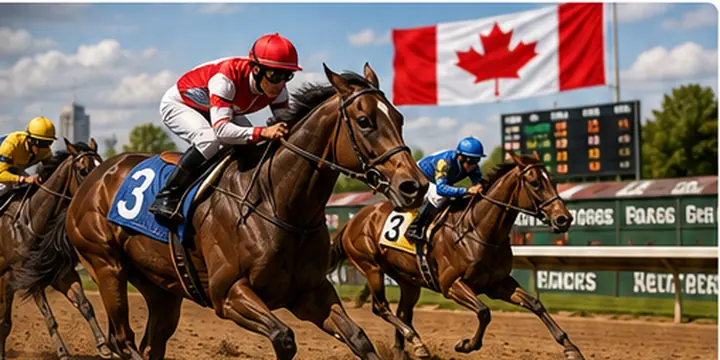
Horse racing is one of the oldest betting markets still widely available in Canada, but it works differently from a typical point-spread or moneyline sportsbook. The biggest difference is the wagering system itself. Most legal Canadian horse-race betting uses pari-mutuel pools, where bettors wager against one another and the final dividend depends on how the money in the pool is distributed.
That structure creates a game of both handicapping and price. You are not only trying to identify the horse most likely to run well. You are also deciding whether the probable payout fairly compensates you for the chance that your selection loses. A strong horse at a very short price can be a poor bet, while a less obvious runner can become interesting if the public underestimates its chances.
Is Horse Betting Legal in Canada?
Horse-race betting occupies a special place in Canadian gambling law. Pari-mutuel wagering on running, trotting and pacing races is authorized under section 204 of the Criminal Code when it is conducted in accordance with the federal rules. The Canadian Pari-Mutuel Agency, or CPMA, is the federal authority responsible for supervising pari-mutuel horse-race betting and for programs that support the integrity of the pools, including the national equine drug-control program.
This is different from the provincial sports-betting framework that Canadian bettors encounter with the NFL, NHL, NBA, CFL, MLB or UFC. The 2021 federal single-event sports-betting changes deliberately preserved the federal horse-racing framework. Provinces still have important roles in licensing racetracks, regulating racing participants and overseeing local gaming matters, but legal pari-mutuel betting remains subject to CPMA supervision.
For a player, the practical rule is straightforward: use a Canadian racetrack, account-wagering service or locally regulated product that is actually authorized to accept your horse-racing wager. Availability, legal age, account requirements and payment methods can vary by province and platform. Being able to reach a foreign website is not the same thing as receiving Canadian regulatory protection.
What Is Pari-Mutuel Betting?
Pari-mutuel literally means betting into a shared pool. Imagine that bettors collectively wager $100,000 into the Win pool on a race. The permitted takeout and other deductions are removed, then the remaining net pool is divided among the tickets that selected the winning horse. If a large percentage of the money was bet on that winner, each winning ticket receives a smaller dividend. If relatively little money supported the winner, the dividend is larger.
This explains why horse-racing odds move. The number beside a horse is not always a fixed promise from a bookmaker. It is an evolving estimate of the payout based on the current pool. Money can arrive quickly in the final minutes, particularly on major cards and simulcast races, so the final odds may be noticeably different from the price you saw when you first considered the bet.
For Canadian beginners, this is the first concept to master. In a fixed-odds sportsbook market, accepting +200 generally locks that price at the time of your bet. In a pari-mutuel Win pool, your ticket participates in the final pool and the dividend is determined after wagering closes and the race becomes official.
How Horse Racing Betting Works Step by Step
- Choose the track and race. Start with a race you can research rather than automatically betting the next race on screen.
- Read the entries and conditions. Note the surface, distance, class, field size, post positions and eligibility conditions.
- Study the horses. Compare recent form, speed, pace, class, trainer, jockey or driver, workouts, layoffs and surface or distance suitability.
- Check the pool and odds. Your handicapping opinion is only half the decision. Compare your estimated chance with the current price.
- Select a bet type. Straight bets are simpler. Exotic and multi-race wagers create larger potential payouts but also require more outcomes to go right.
- Calculate total ticket cost. A boxed or wheeled exotic can contain many combinations. Know the full cost before submitting it.
- Place the wager and keep the receipt. Review track, race number, bet amount, bet type and horse numbers.
- Wait for the official result. Stewards' inquiries, objections or disqualifications can affect the official order and settlement.

Thoroughbred vs Standardbred Horse Racing
Canadian horse betting includes more than one form of racing. Thoroughbred racing is the style most casual fans recognize: mounted jockeys race at a gallop over dirt, synthetic or turf surfaces. Woodbine Racetrack in Toronto is Canada's largest Thoroughbred venue and hosts the King's Plate, Woodbine Mile and Breeders' Stakes.
Standardbred racing, often called harness racing, uses a sulky driven behind the horse. The two principal gaits are pacing and trotting, and horses are required to maintain the prescribed gait. Woodbine Mohawk Park in Milton, Ontario is one of North America's leading Standardbred tracks and hosts major events including the North America Cup, Canadian Pacing Derby, Maple Leaf Trot, Mohawk Million and Metro Pace.
The wagering language overlaps, but handicapping changes. Thoroughbred bettors study factors such as early speed, post, surface, trip, turf form and jockey decisions. Harness bettors place greater emphasis on gate speed, post position, driver tactics, class changes, fractions, parked-out trips and whether a horse is moving between pace and trot conditions or different track sizes.
Win, Place and Show Bets Explained
Win
A Win bet is the cleanest form of horse wagering: your selection must finish first in the official order. It is often the best starting point for learning whether your handicapping process identifies underpriced or overpriced horses because the ticket has one clear opinion and one clear outcome.
Place
A Place bet generally pays when your horse finishes first or second. Because two finishing positions can generate a winning ticket, the payout is usually lower than a comparable Win bet. Place can make sense when you believe a horse is very likely to run well but you are less confident it will actually win.
Show
A Show bet generally wins when the horse finishes first, second or third. It has the widest margin for error among the traditional straight bets, and therefore often has the smallest payout. Very short-priced favourites can produce tiny Show dividends, so the apparent safety of the ticket does not automatically make it good value.
| Bet | What must happen | Difficulty | Typical profile |
|---|---|---|---|
| Win | Your horse finishes 1st | Moderate | Best direct expression of a handicapping opinion |
| Place | Your horse finishes 1st or 2nd | Lower | More forgiving, generally smaller payout |
| Show | Your horse finishes 1st, 2nd or 3rd | Lower | Highest hit rate of the three, often lowest return |
Exacta, Trifecta and Superfecta Betting
Exotic bets ask you to predict multiple finishing positions, which can create larger payouts because far more combinations can lose. Canadian racing materials may use the terms Exactor and Triactor alongside Exacta and Trifecta. The idea is the same: correct order matters unless you deliberately buy a box or another ticket structure that covers multiple orders.
Exacta or Exactor
Select the first and second finishers in the exact order. A 4-7 Exacta requires horse 4 to win and horse 7 to finish second. If 7 wins and 4 is second, a straight 4-7 ticket loses.
Trifecta or Triactor
Select the first three finishers in exact order. The difficulty rises sharply because you are solving three positions, not simply finding the winner.
Superfecta
Select the first four finishers in exact order. Superfectas can produce eye-catching payouts in large, competitive fields, but they can also encourage expensive tickets and low hit rates. The goal is not to cover every possible combination. It is to build a ticket around a specific race opinion.
Boxing, Keying and Wheeling Exotic Tickets
A box allows your selected horses to finish in any covered order. For example, a two-horse Exacta box with 3 and 8 contains both 3-8 and 8-3. A three-horse Trifecta box contains six ordered combinations. Add more horses and the cost grows quickly, which is why bettors should calculate combinations before pressing submit.
A key is more opinionated. You might key horse 3 to win, then use 2, 5 and 8 underneath for second and third. A wheel or part-wheel expands selected positions while keeping another position fixed. These structures are useful when your view is not simply "these are the three best horses" but something more specific such as "horse 3 is the most likely winner, and the vulnerable favourite can miss the exacta."
Ticket structure is part of handicapping. Two bettors can have identical opinions about the race but very different expected results because one spends efficiently around the strongest opinion while the other buys redundant or contradictory combinations.
Daily Double, Pick 3, Pick 4, Pick 5 and Pick 6
Multi-race wagers ask you to identify the winners of consecutive races. A Daily Double covers two specified races. Pick 3, Pick 4, Pick 5 and Pick 6 wagers extend the sequence. These bets can create large payouts because you must be correct repeatedly, and they reward the ability to identify races where a favourite is trustworthy, vulnerable or worth excluding.
The biggest ticket-building mistake is treating every leg equally. If you use four horses in every leg of a Pick 4, the combination count becomes 4 x 4 x 4 x 4 = 256. Even at a modest base stake, the cost can become disproportionate to your bankroll. Stronger players often build around a "single" in at least one leg, meaning they use only one horse where they have a particularly strong conviction.
Carryovers and mandatory payouts can attract large pools, but a larger pool is not permission to bet carelessly. First decide whether you have an edge on the sequence. Then decide whether the ticket fits your budget.
Jackpot Hi-5 and Other Special Pools
A Jackpot Hi-5 generally asks bettors to select the first five finishers in exact order. Rules vary by track and pool, including how much of the pool is paid when multiple winning tickets exist and how much carries forward. Large carryovers can change betting behaviour because more players enter the pool when a mandatory payout is announced.
Always read the pool rules before playing a jackpot wager. The headline carryover is only one part of the equation. You also need to know the minimum stake, takeout, payout conditions and whether the pool can be won in full only by a unique ticket. These details can materially change the value and risk of the wager.
How Horse Racing Odds and Payouts Work
Traditional tote boards often display fractional-style odds such as 2-1, 5-2, 7-1 or 15-1. At 5-1, the rough idea is five dollars of profit for each dollar wagered, plus return of the original stake, subject to the final official dividend and track rules. A $2 ticket at 5-1 would therefore be expected to return approximately $12 if the final price were exactly 5-1.
Because Canadian pari-mutuel wagering is pool based, displayed odds are best treated as a live estimate. They can move when significant money arrives late. This is particularly important with small pools, where one large wager can have a bigger impact than it would in a huge international pool.
Do not confuse a horse's chance of winning with whether it is worth betting. If you believe a horse wins 30 percent of the time, the fair odds are roughly 2.33-1 before accounting for takeout and other realities. If the public is offering only even money, you may correctly identify the most likely winner and still have a poor betting opportunity.
Morning Line vs Final Odds
The morning line is a pre-race estimate designed to forecast how the betting market may price the field. It is useful as a reference, but it is not the price you are guaranteed to receive. The actual pari-mutuel price is determined by the betting pool.
This distinction matters for value betting. Suppose a horse is listed at 8-1 on the morning line and you believe it should be around 5-1. If the public sends the horse off at 3-1, the attractive value may have disappeared. Conversely, a morning-line favourite may drift because bettors prefer other runners, creating a better price than you expected.
Takeout, Pool Size and Why They Matter
Before pari-mutuel winnings are distributed, permitted deductions are taken from the pool. The remaining net pool funds the payouts to winning tickets. Takeout rates can differ by wager type, which is one reason a disciplined bettor should not look only at jackpot size or projected payout.
Pool size also affects stability. Large pools generally absorb individual wagers with less movement. Small pools can be more volatile, particularly in the final minutes. If you are betting a large amount relative to the pool, your own wager can even shorten the price you receive.
The federal CPMA levy that supports supervision and integrity programs increased to 1.0 percent effective July 1, 2026. That is part of the regulatory economics of Canadian pari-mutuel betting, not a reason for a player to ignore the track's own published takeout and pool rules.
How to Read a Horse Racing Form
A racing form or past-performance page compresses a horse's recent history into lines of data. Formats differ, but the core questions are similar: what class has the horse faced, how fast did it run, where was it positioned during the race, what surface and distance was involved, how long since the previous start, and who trained and rode or drove it?
Beginners often focus on finishing position. A fourth-place finish can be excellent if the horse faced a much stronger field, raced wide, set a demanding pace or was blocked at a critical point. A win can be less impressive if the horse controlled a slow pace against weak competition. Read the line as a story, not just a rank.
Useful details include dates, tracks, distances, surfaces, class conditions, fractional times, speed figures, beaten lengths, comments, odds, equipment, medications where shown, jockey or driver changes and trainer statistics. The goal is to reconstruct what happened and decide whether today's race creates a better or worse setup.
Pace Handicapping
Pace describes how quickly a race develops and which horses are expected to compete for position at each stage. In a Thoroughbred sprint, several aggressive front-runners can produce a fast early pace and create an opportunity for a stalker or closer. If one horse appears to control the lead without pressure, the same runner may conserve energy and become difficult to catch.
Do not simply label horses "fast" or "slow." Ask how their preferred running styles interact. A horse with excellent early speed can be disadvantaged if three rivals have the same need for the lead. A closer with a strong late kick can be compromised in a race lacking enough early pressure.
Harness racing has its own pace dynamics. Leaving speed, post position and the risk of racing first-over or parked without cover can have major effects on energy use. Driver intent and track configuration can matter as much as raw final time.
Class and Competition Level
Class describes the quality and conditions of competition a horse has been facing. Maiden races are for horses that have not yet won. Claiming races involve horses entered at specified claiming prices. Allowance, optional claiming and stakes races generally move up the quality ladder, although exact conditions matter.
A class drop can make a horse more competitive, but it is not automatically positive. A significant drop after a poor performance may signal that connections are seeking easier company, but it can also raise questions about current condition. A class rise can look intimidating, yet improving horses frequently move up after a strong win and may still be underpriced.
Speed Figures and Raw Time
Raw finishing times are difficult to compare because tracks, surfaces, weather and pace conditions differ. Speed figures attempt to normalize performance into a more useful number. They can be valuable, but no figure is a complete forecast.
Use speed figures to identify the level a horse has already demonstrated, then ask whether today's circumstances support repeating it. A career-best number earned with a perfect trip on a preferred surface may be less repeatable than a slightly lower figure produced despite traffic or a difficult pace.
Surface and Track Condition
Thoroughbred races can be contested on turf, dirt or synthetic surfaces. Woodbine's main Thoroughbred course uses a synthetic surface, and its turf racing creates a different handicapping environment. A horse can be highly effective on one surface and ordinary on another.
Weather changes the problem. Dirt can become sloppy or muddy. Turf can range from firm to yielding or soft. Synthetic surfaces may respond differently to temperature and maintenance. Instead of assuming wet weather helps or hurts every horse equally, study previous races on comparable going and consider pedigree when direct evidence is limited.
Distance and Post Position
A horse proven at six furlongs may not be equally effective at a mile and a quarter. Distance changes how early speed, stamina and finishing ability are balanced. Routes can reward horses able to relax and conserve energy, while short sprints place greater pressure on breaking sharply and securing position.
Post position matters in context. An outside draw can force extra ground around the first turn at some distances. An inside draw can create traffic risk for a horse without enough early speed. In harness racing, the outside posts can be particularly demanding because the field starts behind the gate and drivers must decide how aggressively to leave.
Jockeys, Drivers and Trainers
Human connections matter, but they should not replace analysis of the horse. A top jockey cannot make a slow horse fast, and a leading trainer cannot guarantee that a runner handles today's surface or class. Still, rider and trainer decisions influence positioning, pace, equipment, race selection and preparation.
Look beyond win percentage. Some trainers excel with first-time starters, layoffs, turf switches or claims. Some drivers are especially effective at a specific harness track. A jockey change can signal intent, but the market often notices high-profile names quickly, so popular connections can also be overbet.
Workouts, Layoffs and Form Cycles
A horse returning from a long break may be fully prepared or may need a race before reaching peak fitness. Workout patterns, trainer history and the level of today's race can help frame that uncertainty. A string of consistent works can be encouraging, but workout speed alone does not reveal everything about intent or conditioning.
Form cycles matter because racehorses are athletes, not static data points. Improving young horses can make large jumps between starts. Older runners may maintain a stable level for months and then decline. A recent bad race can be a genuine warning or a forgivable result caused by pace, trip, surface or health.
Favourites, Longshots and Value
Horse betting is not about avoiding favourites or chasing longshots. It is about comparing probability with price. A 4-5 favourite can be a value bet if you believe it wins far more often than the market implies. A 20-1 horse can be a bad bet if you believe its real chance is closer to 100-1.
The public tends to concentrate money on obvious information such as a famous jockey, a recent win or a strong speed figure. Those factors matter, but when everyone sees the same evidence the price can become too short. Contrarian betting only makes sense when supported by a reasoned handicapping case.
Canadian Horse Racing in 2026: Dates to Know
Woodbine's 2026 Thoroughbred season runs from April 18 through December 13 with 128 scheduled race dates. The stakes calendar is highlighted by the King's Plate on August 15 and the Grade 1 Woodbine Mile on September 12.
The 2026 Canadian Triple Crown for Canadian-bred three-year-olds begins with the King's Plate at Woodbine on August 15. The second leg, the Prince of Wales Stakes, is scheduled for September 7 at Fort Erie. The Breeders' Stakes completes the series at Woodbine on September 27. Each leg uses a different racing surface and distance profile, which is one reason the Triple Crown is such a demanding series.
Standardbred fans have a separate marquee calendar at Woodbine Mohawk Park. The 2026 North America Cup is scheduled for June 13. The Canadian Pacing Derby and Maple Leaf Trot are scheduled for September 5, while the Mohawk Million and Metro Pace are scheduled for September 26.
| 2026 event | Date | Venue | Type |
|---|---|---|---|
| North America Cup | June 13 | Woodbine Mohawk Park | Standardbred pace |
| King's Plate | August 15 | Woodbine | Canadian Triple Crown leg 1 |
| Canadian Pacing Derby / Maple Leaf Trot | September 5 | Woodbine Mohawk Park | Standardbred |
| Prince of Wales Stakes | September 7 | Fort Erie | Canadian Triple Crown leg 2 |
| Woodbine Mile | September 12 | Woodbine | Grade 1 Thoroughbred |
| Mohawk Million / Metro Pace | September 26 | Woodbine Mohawk Park | Standardbred |
| Breeders' Stakes | September 27 | Woodbine | Canadian Triple Crown leg 3 |

King's Plate Betting for Canadians
The King's Plate is Canada's most prestigious Thoroughbred race and a natural entry point for casual bettors. Big-race cards attract more public money, larger fields and many one-day bettors, which can create unusual pricing. Do not assume the horse with the best story, most media attention or shortest morning line is automatically the best value.
Canadian-bred three-year-olds can develop rapidly through the spring and summer. Pay attention to prep races, distance progression, pedigree, synthetic-surface form and whether a horse's running style fits the expected Plate pace. The 2026 race is scheduled for August 15 at Woodbine.
Betting the Canadian Triple Crown
The Canadian Triple Crown tests versatility because the three races do not simply repeat the same assignment. Bettors should treat each leg as a new handicap rather than carrying forward the first race result without adjustment. Surface, distance, pace and recovery time can create very different conditions.
A horse that excels at Woodbine may face new questions at Fort Erie, while the longer Breeders' Stakes can reward a different balance of stamina and turf ability. When the same runners meet again, compare trip and pace from the previous leg rather than only the finish order.
How to Bet Standardbred and Harness Racing
Harness racing rewards a slightly different reading of the program. Pay attention to post position, early speed, driver changes, class moves and recent fractional times. A horse leaving from an outside post may expend significant energy trying to secure position. A runner trapped behind tiring horses can have far more ability than the finishing position suggests.
Pacing and trotting are separate gaits. Horses can break stride, which can dramatically alter the race and may lead to disqualification depending on the circumstances and rules. For bettors accustomed only to Thoroughbred racing, learning the terminology and how trips develop behind the starting car is worth the effort before wagering.
Betting International Horse Racing from Canada
Authorized Canadian wagering platforms can make races from around the world available through simulcasting and commingled pools. Major U.S. events such as the Kentucky Derby, Preakness, Belmont Stakes and Breeders' Cup are familiar examples, while Canadian bettors may also see racing from Europe, Australia, Japan, Dubai and other jurisdictions.
Do not assume the handicapping data or bet terminology is identical everywhere. Turf conditions, race distances, starting procedures, medication rules, field sizes and local pool structures can differ. A disciplined player learns the local context before applying a North American handicapping model to an unfamiliar circuit.
Online Horse Betting in Canada
Canadian bettors can access horse racing through authorized account-wagering channels, racetrack services and, in some jurisdictions, integrations with provincial or regulated online gaming products. Woodbine identifies HPIbet as a major Canadian horse-racing wagering platform and notes that it provides access to hundreds of racetracks worldwide. In Ontario, Woodbine also lists horse-racing access through OLG.ca and regulated online sportsbook integrations.
Before creating an account, confirm residency requirements, legal age, supported province, deposit and withdrawal methods, geolocation rules, available tracks, minimum wagers, live video access and responsible gambling controls. Horse-racing accounts can differ from a standard sportsbook wallet even when both are available through the same broader gaming ecosystem.
Mobile Horse Betting
Mobile wagering is especially useful for racing because the market moves close to post time. A good mobile interface should make it easy to switch tracks, view pool odds, read scratches, confirm race number, construct tickets and verify the total stake before submitting.
The danger is speed. It is easy to treat each approaching post time as an invitation to bet. Build your race list before the card begins and use alerts or favourites only to support that plan. Mobile convenience should reduce friction in research and ticket entry, not remove the discipline of deciding which races to skip.
Horse Betting Bonuses and Promotions
Horse-racing promotions can include rebates, cashback, boosted rewards, deposit offers, insurance-style promotions or special contests tied to a track or event. Promotional value depends on the terms. A rebate on eligible wagering can be more useful to a high-volume horseplayer than a flashy offer tied to a narrow bet type, but only if the extra wagering fits a pre-existing plan.
Read opt-in requirements, minimum stakes, eligible tracks, eligible pools, expiration dates, maximum promotional credit and withdrawal conditions. Never create extra bets simply to reach a promotional threshold.
Horse Betting Bankroll Management
Horse racing can be particularly hard on bankrolls because a race card contains repeated opportunities and exotic wagers can multiply combinations. Set a card budget before the first race. Within that amount, decide what portion belongs to straight bets, exotics and multi-race sequences.
One simple approach is to think in units. If one unit is 1 percent of your dedicated entertainment bankroll, a normal Win bet might be one unit and a high-variance exotic could be a fraction of a unit. The exact percentages are less important than consistency and affordability.
Keep records by bet type. A bettor can be profitable on Win wagers while consistently losing on trifectas, or the reverse. Tracking reveals whether a favourite market is actually helping the bankroll or simply producing the most excitement.
How to Calculate Exotic Ticket Cost
Ticket cost should never be a surprise. Multiply the number of combinations by the base stake. A three-horse Exacta box contains six ordered combinations. At a $1 base, it costs $6. A four-horse Trifecta box contains 24 ordered combinations. At a $1 base, it costs $24. A five-horse Trifecta box contains 60 combinations and would cost $60 at the same base.
This is why broad boxes can quietly overwhelm a bankroll. If your real opinion is that one horse should win, a keyed ticket may express that view more efficiently than boxing five runners and hoping one combination survives.
Common Horse Betting Mistakes
- Betting every race. More races do not create more value.
- Ignoring final price. A good horse can become a bad bet when the odds collapse.
- Overboxing exotics. Covering every combination can erase the reason you handicapped the race.
- Chasing scratches and late changes emotionally. Recalculate the race instead.
- Judging only by last finish. Trip, pace, class and surface can matter more than position.
- Confusing morning line with guaranteed odds. Pari-mutuel prices are determined by the pool.
- Underestimating ticket cost. Multi-horse combinations compound quickly.
- Chasing losses into the next track. Racing can continue for hours across time zones.
A Practical Horse Betting Strategy
A useful process starts with handicapping before looking at the odds. Rank the horses by estimated winning probability, then compare your view with the market. This helps reduce the temptation to invent a case simply because a longshot price looks exciting.
Second, decide what your strongest opinion actually is. If you think horse 5 is the most likely winner but the favourite is vulnerable underneath, that suggests a different ticket from simply betting a five-horse trifecta box. If you think two horses dominate the race, a Win bet, Exacta or multi-race sequence may express the idea more efficiently.
Third, pass when the price does not justify the risk. Professional-style betting is often defined as much by the races ignored as the races played.
Responsible Horse Betting
Horse racing can create a rapid cycle of anticipation because another race is always approaching. Treat that frequency as a risk factor. Set a time limit and dollar limit before opening the wagering app or arriving at the track. Do not use money required for rent, food, debt, savings goals or family expenses.
If betting stops feeling recreational, use the limit, timeout and self-exclusion tools available through your platform and consult the responsible gambling resources for your province. Chasing is especially dangerous in racing because a loss can immediately tempt you into the next post time. A new race does not improve the quality of the previous decision.
Horse Betting Glossary
Across the board
Separate Win, Place and Show bets on the same horse.
Also eligible
A horse entered on a waiting list that may draw into the race after scratches.
Box
An exotic ticket structure that covers the selected horses in multiple finishing orders.
Closer
A horse whose strongest running is usually produced late in the race.
Exactor / Exacta
A wager requiring the first two finishers in exact order.
Favourite
The betting interest with the shortest odds in a pool.
Furlong
A racing distance equal to one eighth of a mile.
Morning line
A pre-race estimate of how the betting public may price the field.
Pari-mutuel
A pool-based wagering system where winning tickets share the net pool after permitted deductions.
Post position
The assigned starting gate or starting position for a horse.
Scratch
A horse removed from the race before it is run.
Triactor / Trifecta
A wager requiring the first three finishers in exact order.
Official Canadian Horse Racing Sources
For current Canadian rules, use official sources rather than relying only on a betting guide. The Canadian Pari-Mutuel Agency publishes regulatory information and industry notifications. Woodbine publishes race calendars, stakes schedules, wagering rules and beginner betting material. Provincial racing regulators and racetrack operators publish local licensing and racing rules.
- Canadian Pari-Mutuel Agency
- Criminal Code section 204
- Woodbine beginner betting guide
- Woodbine stakes schedule
Frequently Asked Questions
Yes, legal pari-mutuel betting on horse racing operates under a distinct federal framework supervised by the Canadian Pari-Mutuel Agency under section 204 of the Criminal Code. Racetracks and racing participants are also subject to provincial oversight. Always use an authorized racetrack, account-wagering platform or locally regulated product available where you live.
Pari-mutuel betting places wagers of the same type into a common pool. After permitted deductions, the remaining pool is divided among winning tickets. Because the pool changes as money arrives, displayed odds can move until betting closes and final payouts are not known in advance.
A Win bet is the simplest because you choose one horse to finish first. Place and Show bets give more ways to cash but normally pay less. Beginners should understand these straight bets before moving to exactas, trifectas or multi-race wagers.
A Win ticket needs the horse to finish first. A Place ticket generally wins if the horse finishes first or second. A Show ticket generally wins if the horse finishes first, second or third. Exact rules and minimum stakes should always be checked with the wagering platform.
An Exacta, also called an Exactor in some Canadian racing materials, requires you to select the first two finishers in the exact order. A box allows the selected horses to finish in either order, but the ticket costs more because it contains multiple combinations.
A Trifecta, also called a Triactor in Canadian usage, requires the first three finishers in the exact order. Because the number of possible combinations grows quickly, ticket construction and total cost matter as much as the horses you select.
In pari-mutuel pools, odds are a reflection of how the betting money is distributed. A horse receiving a larger share of the Win pool becomes a shorter price. Late wagers can therefore change the displayed odds and the final payout.
The morning line is an estimate made before wagering develops. It is not a guaranteed price. Actual odds are set by betting activity in the pari-mutuel pool, so a horse listed at 6-1 on the morning line may start at a very different final price.
Useful inputs include recent finishing positions, speed figures, pace, class level, surface, distance, post position, trainer and jockey or driver statistics, layoffs, workouts and whether today's conditions differ from recent races. No single statistic should be used by itself.
The King's Plate is Canada's most prestigious Thoroughbred race and the first leg of the Canadian Triple Crown. In 2026 it is scheduled for August 15 at Woodbine Racetrack, followed by the Prince of Wales Stakes on September 7 and the Breeders' Stakes on September 27.
Authorized Canadian account-wagering platforms can offer wagering on many approved races from outside Canada. Federal rules govern pari-mutuel betting on imported race signals, and the exact tracks available depend on the wagering provider and regulatory approvals.
Set a fixed entertainment budget, decide your maximum stake before the card starts, track the total cost of exotic combinations, and avoid increasing stakes to recover losses. Horse racing has many races and many bet types, so disciplined selectivity is more important than constant action.
Track Bias and How Bettors Use It
A track bias exists when one part of the course or one running style appears to have an unusual advantage. A dirt surface can favour inside speed on one day and play fairly on another. Turf rails can be moved, maintenance can change, weather can alter moisture and small samples can create the illusion of a bias that is not actually persistent.
Use bias as evidence, not as a shortcut. Watch the races, compare expected contenders with results and ask whether winners succeeded because of surface advantage or because they were simply the best horses. If a genuine bias develops, the market often catches up, so early recognition matters more than blindly applying yesterday's conclusion.
Trip Handicapping
Trip handicapping focuses on what happened during the race rather than only the final number. Horses can lose ground racing wide, become trapped behind slower rivals, break poorly, check sharply, fight the rider, encounter traffic or make an early move into an unsustainable pace.
Replay review can uncover performances that look ordinary on paper but were better than the finishing position suggests. The opposite is also true: a winner can benefit from a perfect rail trip and soft pace, making the result difficult to repeat at a shorter price next time.
Field Size and Betting Opportunity
Large fields create more possible outcomes and often more attractive exotic payouts, but they also create more traffic and uncertainty. Small fields can be easier to understand tactically, yet short prices can make value difficult to find.
Do not judge a race by field size alone. A ten-horse field with six obvious non-contenders can be more straightforward than a six-horse field where every runner has a plausible winning case.
Betting Maiden Races
Maiden races contain horses that have not yet won, and they can include first-time starters with limited public evidence. These races require more attention to pedigree, workouts, trainer patterns, sale prices and how experienced runners have performed against similar company.
First-time starters create uncertainty that can be either a risk or an opportunity. The public often overreacts to fashionable pedigrees and high-profile trainers. Your edge comes from estimating how much uncertainty is already reflected in the price.
Claiming, Allowance and Stakes Races
Claiming races are built around a specified claiming price, while allowance races use eligibility conditions rather than making every horse available for purchase. Stakes races typically feature higher-quality competition and can include nomination requirements, restricted eligibility or graded status.
Class comparisons are not perfectly linear. A strong claiming race can produce a better field than a weak allowance event. Read the actual conditions and examine who the horses have faced rather than relying only on the label.
Horseplayer Tournaments
Some Canadian wagering platforms and racetracks offer handicapping tournaments where players compete based on a defined bankroll, required wagers or points system. Tournament strategy can be different from ordinary betting because your objective is to outperform other entrants rather than simply maximize the expected value of an isolated wager.
Late in a contest, standings matter. A player protecting a lead may prefer a conservative selection while a player far behind may need a larger-priced horse. Always read the tournament rules, eligible tracks, minimum wager requirements and whether the format uses real money or mythical bankrolls.
Horse Racing Betting vs Traditional Sportsbook Betting
| Feature | Pari-mutuel horse racing | Typical fixed-odds sports bet |
|---|---|---|
| Who sets the price? | Pool distribution determines final dividend | Sportsbook posts a fixed price |
| Does price move after bet? | Displayed odds can move until pool closes | Accepted price is normally locked |
| Main Canadian regulator | CPMA federally supervises pari-mutuel wagering | Provincial/territorial gaming framework |
| Core skill | Handicap horse plus judge pool value | Handicap event plus compare sportsbook price |
| Common bet types | Win, Place, Show, Exacta, Trifecta, Pick bets | Moneyline, spread, total, props, parlays |
How to Choose Which Races to Bet
Start by asking whether the race offers enough information and enough disagreement with the public to justify a wager. Competitive stakes races can be exciting but difficult. Low-level claiming races may be less glamorous but can produce clearer pace or class edges. There is no requirement to bet the feature race simply because it has the largest purse.
Create a short list before post time. Mark races where you have a strong pace view, a vulnerable favourite, a horse improving under today's conditions or a multi-race sequence with one strong single. Passing the rest is a legitimate outcome.
Late Odds Movement
One of the most frustrating experiences for new horse bettors is watching a price change near post time. This is a normal feature of pari-mutuel pools. Large account wagers, simulcast money and final-minute betting can change the percentages after your ticket is entered.
Build a minimum acceptable price into your process. If you believe a horse is only worth betting at 4-1 or higher, monitor the pool and be prepared to pass if the price falls. The discipline to abandon a correct handicapping opinion at the wrong price is a major part of long-term betting skill.
Scratches, Rider Changes and Other Late Changes
A scratch can completely change pace and odds. If the main speed horse comes out, another runner may inherit an uncontested lead. If the favourite scratches, money redistributes through the pool and every remaining horse's price can change.
Also monitor rider or driver changes, equipment notes, surface switches and races moved off turf. Never treat your earlier handicap as final when the conditions that created it have changed.
Photo Finishes, Inquiries and Official Results
Your ticket is settled on the official result, not necessarily the order you first see at the finish. Stewards can review interference, objections or other incidents. A photo finish can determine close placings. Wait until the result is declared official before treating a ticket as a win or loss.
Horse Betting Key Takeaways
- Canadian pari-mutuel horse betting has a distinct federal regulatory framework supervised by the CPMA.
- Final pari-mutuel odds depend on the betting pool and can move until wagering closes.
- Learn Win, Place and Show before using high-variance exotic wagers.
- Price matters as much as picking the most likely winner.
- Read past performances in context: pace, class, surface, distance and trip all matter.
- Exotic ticket cost grows rapidly with additional combinations.
- Canadian racing includes both Thoroughbred and Standardbred circuits.
- The King's Plate, Canadian Triple Crown and major Woodbine Mohawk Park stakes provide major 2026 calendar anchors.
- Use authorized Canadian wagering channels and verify current province-specific requirements.
- Set bankroll and time limits before the first race, not after losses occur.